

Note: this is a new series for free subscribers and is intended to give an insight into the work that goes into The Weekly ChartStorm + provide a little further explanation on charts and concepts.
While most people are focused on AI stocks and Big Tech, this equal-weighted basket of space stocks* is up 17x off the low point in late-2022.
This reflects some major strides that several of these companies are making as the commercial space sector goes from dream to reality, but a key part of the more recent run-up is also down to anticipation of the SpaceX IPO.
My personal view is the commercial space sector and space economy will one day be much larger than even some of today’s biggest themes and sectors, and has a lot of growth ahead.
So I reckon this is something to pay more attention to if it’s not yet on your radar, and it’s probably still early days in this story…
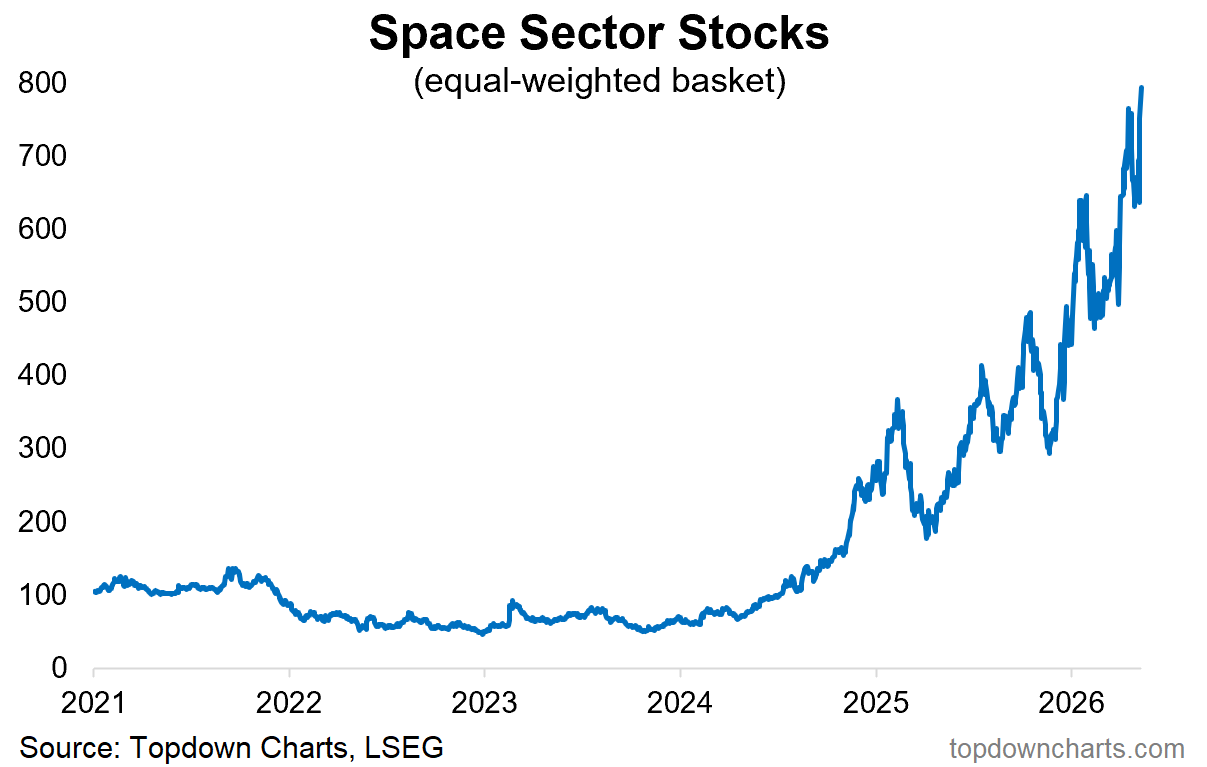
Bottom line: space sector stocks have soared.
*RKLB, LUNR, RDW, VOYG, ASTS, PL, FLY, SPIR, BKSY, SATS
Sign up to the Weekly ChartStorm for more updates…
Subscribe for timely updates, ideas, and insights on the stockmarket.
If you’re already a subscriber check out the Latest Edition + join the comment section Q&A discussions.
Further Thoughts: ETF Market Share and the Future of the Space Sector…
While space sector stocks will almost certainly go through cycles of major boom and bust along the path (just look at the drawdowns in the chart above), I think that path is headed much higher in the longer arc of history.
There’s a few reasons for that.
While major progress has been made in the commercial space sector, it’s still early days. Only a handful of companies have a proven track record for launch services so far — and outside of launch, most companies are either focused on manufacturing and/or operating satellites (with much of the current use case being earth observation and telecommunications).
In the longer run it’s natural to expect this to expand to an array of orbital activities such as zero-gravity manufacturing, orbital space habitats for a variety of use cases (from tourism to media, science/R&D, defense) and logistics.
Further out (literally and figuratively) there will be science, tourism, resource extraction/processing/logistics and a host of things we can’t even imagine yet on the moon, near-earth asteroids, mars, and deep space. Particularly as we meet resource and environmental constraints on earth.
But even without that, the reality right now is that we are entering into a new space age where the big drop in cost to orbit is enabling new companies to do new things and open up whole new industries.
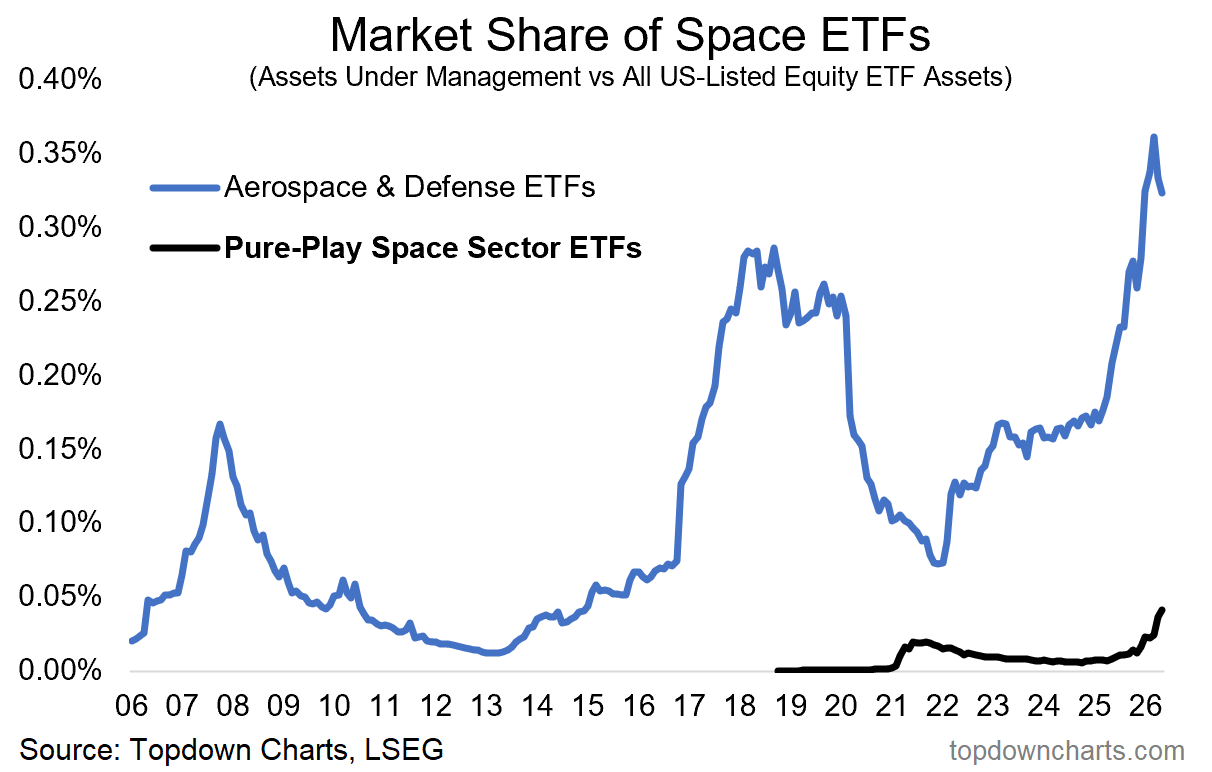
Coming back to earth, one interesting angle is that space focused ETFs (such as UFO, ARKX, NASA, ROKT, MARS) currently have a market share of about 0.04% — that compares to 0.32% for Aerospace & Defense ETFs (and a market cap weight for US Aerospace & Defense of just over 2%).
That means 2 things: 1. the average investor has very little exposure to this corner of the market, and 2. there’s a lot of room to move to the upside as the industry develops further and investors finally catch-on to what’s going on here.
Thanks for reading!
For more info on the Weekly ChartStorm service see:
Upgrade to paid to unlock the latest reports + participate in Q&A discussions.
Lastly, be sure to reach out at any time if I can help with anything. I promise to leave no questions unanswered and no problems unsolved.
—
Best wishes,
Callum Thomas
Founder & Editor of The Weekly ChartStorm
and Head of Research at Topdown Charts
Twitter/X: https://twitter.com/Callum_Thomas
LinkedIn: https://www.linkedin.com/in/callum-thomas-4990063/
Already a paid subscriber?
Log-in and read the latest report here:

.
The equal weighted move masks heavy dispersion underneath. Curious how much of this run is RKLB and ASTS pulling the average versus broad participation across the basket. Index returns rarely tell the whole story when constituents trade on very different theses.
Equal weighted basket masks heavy dispersion. Pure plays versus defense primes with space exposure have very different cash flows and contract visibility. The aggregate looks parabolic, but composition matters more than the trend here.